Sheldon, Illinois
Silent SpringSheldon, Illinois, and the surrounding area of Iroquois County became a central example in Rachel Carson’s account of the consequences of chemical eradication campaigns. Beginning in 1954, government agencies treated land there with dieldrin against the Japanese beetle; as the program expanded, the promised beetle-free outcome receded while wildlife losses and other evidence of poisoning accumulated. Sheldon’s significance lies in this contrast between a narrowly defined target and the much wider living community exposed to the effort to destroy it.
Setting and Campaign
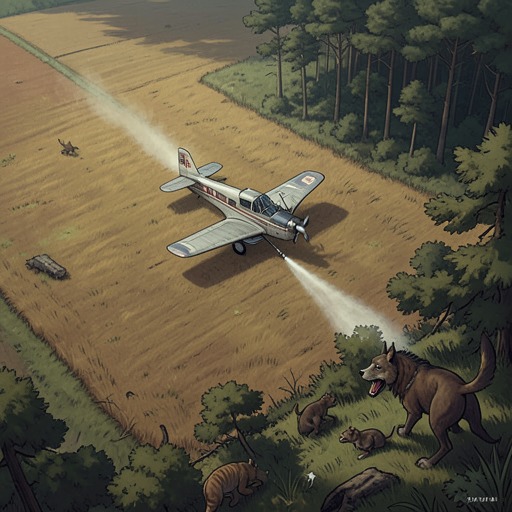
The campaign began as the Japanese beetle advanced into Illinois. In 1954 the United States Department of Agriculture and the Illinois Department of Agriculture launched a program intended to eradicate it, offering the hope—and assurance—that intensive spraying would destroy the invading populations. That year, dieldrin was applied by air to 1,400 acres around Sheldon; in 1955, another 2,600 acres received similar treatment. The initial applications were evidently treated as if the task might be complete, but further chemical treatments were called for rather than the promised finality.
The scale changed sharply over the following years. By the end of 1961, about 131,000 acres had been treated. In Carson’s account, that expansion places Sheldon within a wider postwar period of rapidly increasing public and private spraying, but the local figures make the policy legible on the ground: an operation begun across a few thousand acres became a continuing intervention over a vastly larger area. The campaign’s declared objective remained the beetle; the area subjected to treatment, and the organisms exposed there, extended far beyond that single target.
Exposure and Wildlife Losses
The early Sheldon applications used dieldrin at a rate of three pounds per acre. Carson emphasizes that the danger to insect-eating birds arose not only from the chemical selected but also from the conditions created by its application. Rain left puddles where birds were seen drinking and bathing a few days after spraying; such contact brought the insecticide into their environment and put them at risk. The account thus connects a measured application rate and a particular exposure route to the wider effects of treating inhabited landscapes.
Evidence of reproductive harm accompanied the reported deaths. Some nests were found in treated areas, and some contained eggs, but none contained young birds. Carson presents the empty outcome as a warning that survival alone did not establish that wildlife had escaped the campaign’s effects: birds that lived through the initial exposure may nevertheless have been rendered sterile. The distinction between immediate mortality and failed reproduction broadens the account from a record of individual losses to a threat to the continuation of animal populations.
Birds were not the only wild animals affected. Ground squirrels were described as virtually annihilated, and dead muskrats and rabbits were found in treated areas. These losses show how a program directed at an insect could spread through the larger community of animals sharing the treated land. Sheldon’s story is therefore not simply that the intended pest persisted; it is that the attempt to eliminate it exposed a range of other species to the same intervention.
Domestic Animals and the Measure of Cost
The poisoning campaign also reached beyond wildlife. Carson reports that cats were among the casualties in Sheldon, with the price of a cat more than doubling as a result. The rise in price registers a local consequence in everyday terms: domestic animals had become scarce enough for their loss to alter what residents paid to replace them. The comparison in the book with cats becoming rare in Venezuela after spraying by the World Health Organization places Sheldon within a broader pattern, while preserving the local detail as evidence of how far the effects extended.
Observations of several sheep flocks and a herd of beef cattle provided further indications of the poisoning and death that threatened livestock. These observations matter because they bring animals kept for human use into the same account as birds and small wild mammals. The intended boundary of the program—control of a particular beetle—did not coincide with the boundary of exposure. Sheldon’s landscape held domestic companions, livestock, and wildlife together, and the recorded consequences crossed those categories.
What Sheldon Reveals
The campaign’s repeated treatments and expanding acreage stand in tension with the original assurance of eradication. Instead of a completed operation after the 1954 and 1955 applications, the program demanded further chemical intervention and ultimately covered about 131,000 acres by 1961. Sheldon thus illustrates a central problem in the book’s treatment of insect control: success defined as the destruction of one target can conceal the costs borne by organisms that were not the target, while continued treatment itself becomes evidence that the promised solution has not brought the issue to a close.
Carson’s use of Sheldon also makes place essential to the argument. The consequences are not left as an abstract warning about pesticides: they are attached to a named Illinois community, a sequence of dated applications, a stated dose, rainwater used by birds, empty nests, lost animals, and threatened livestock. Together these particulars give the eradication policy an ecological and local scale. Sheldon represents the distance between a campaign’s narrow administrative aim and the broad living world on which its execution acted.